
· Adrian Costa
Best beginner tarantulas: species, lifespan and difficulty
Every keeper remembers their first tarantula, and the species you start with shapes the whole experience. Some species are calm, forgiving and content in a simple setup. Others are fast, defensive or fragile, and they punish beginner mistakes. This guide walks through the species that keepers have recommended to newcomers for decades, compares their temperament, growth and lifespan in one table, and points each one to the enclosure shape it actually needs.
What makes a species beginner-friendly
Four traits separate a good first tarantula from a stressful one. First, temperament: a beginner species should be slow-moving and reluctant to defend itself, so that routine maintenance never turns into a chase. Second, hardiness: the best starter species tolerate the small temperature and humidity swings of a normal room without special equipment. Third, venom: the classic recommendations are all New World species whose bites are considered medically minor, unlike some fast Old World tarantulas that are best left until later. Fourth, lifestyle: ground-dwelling species are more forgiving than tree-dwellers, because a terrestrial setup has fewer ways to go wrong.
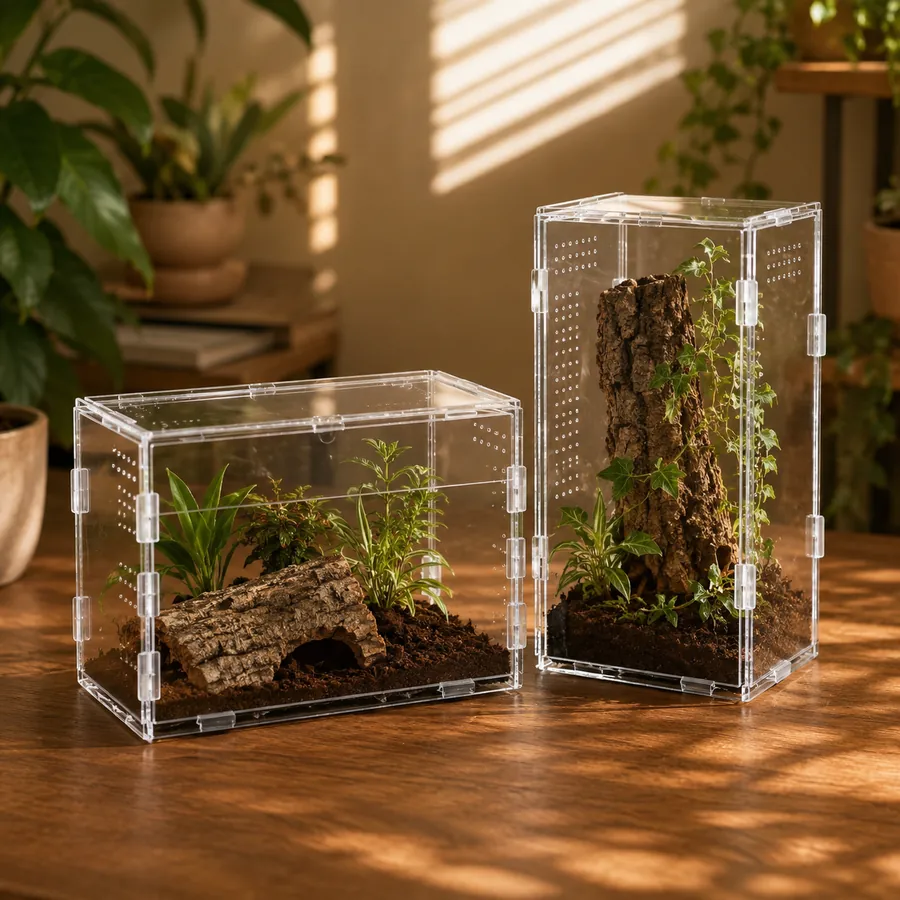
That last trait decides your enclosure before anything else, and it is the one axis where the beginner list splits. Five of the six species below live on the ground; one lives in the trees. The full explanation of how that split changes the housing is in the arboreal vs terrestrial guide, so here we stay focused on the animals themselves.
Availability counts as a fifth, quieter trait: every species below is widely captive-bred, so a newcomer can start with a healthy, well-started spider of known age instead of a wild-caught unknown.
described tarantula species, yet the beginner shortlist has stayed at the same handful of names for decades
— World Spider Catalog, 2024
The five terrestrial picks
These five ground-dwellers make up the core of almost every beginner list, and they all live in the same shape of home: a wide, low terrestrial tarantula enclosure with deep substrate and a hide.
Chilean rose (Grammostola rosea). The Chilean rose is probably the most widely kept pet tarantula in history. It is slow-moving, generally placid and famously undemanding: room temperature, a water dish and a dry setup cover its needs. Its quirks are behavioral rather than dangerous. Roses are known for skipping meals for long stretches and for rearranging their enclosure on a whim, and individual personalities vary more than in any other species here. Growth is slow, which means a rose bought young will spend years in each enclosure size before needing the next one.
Mexican red knee (Brachypelma hamorii). The red knee is the poster tarantula: jet-black body with vivid orange knees, the species most people picture when they hear the word. It is docile, slow and very long-lived, with females that can outlast most family dogs and cats combined. Like many New World species it can flick urticating hairs when stressed, which is one more reason the hobby standard is to enjoy it through the clear wall rather than on your hand. As a display animal in a clean acrylic enclosure, few species come close.
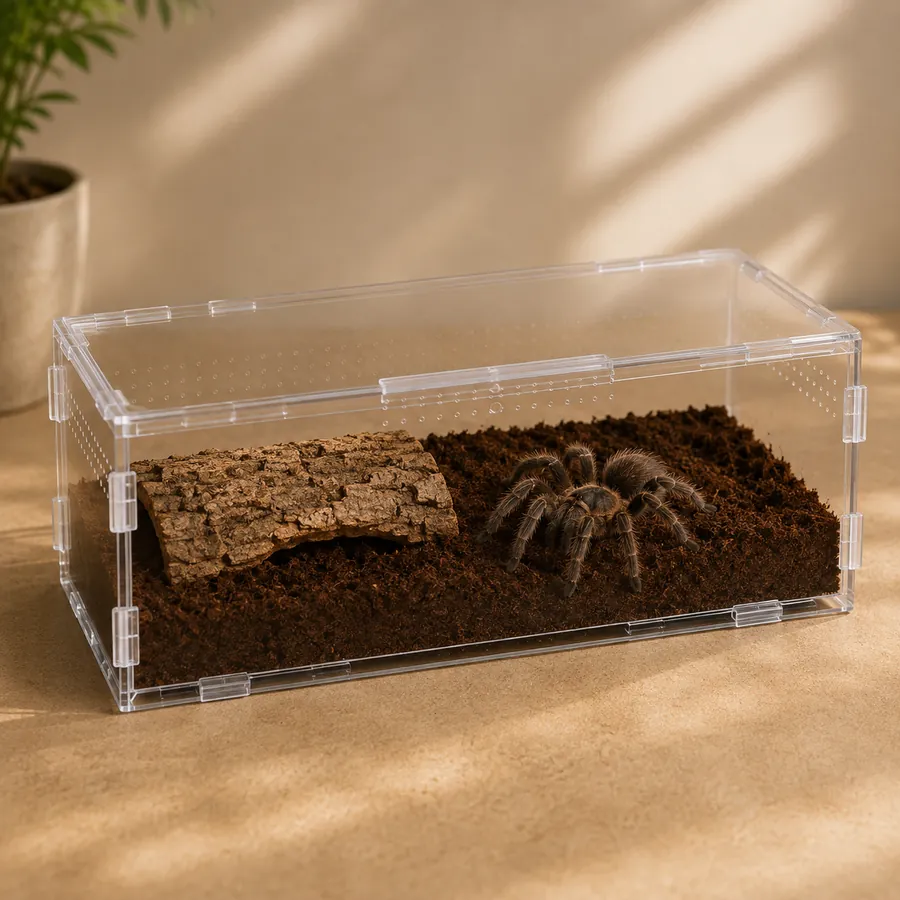
Brazilian black (Grammostola pulchra). Ask experienced keepers for the calmest tarantula in the hobby and the Brazilian black comes up again and again. It pairs the hardiness of its cousin the Chilean rose with a steadier, more predictable disposition and a deep velvet-black look. It grows slowly and is usually sold small, which makes it a perfect candidate to start in a sling enclosure and upgrade as it grows. If your priority is a first spider that almost never gives you a tense moment, this is the one.
Arizona blonde (Aphonopelma chalcodes). The Arizona blonde is a desert species built for neglect-level hardiness: it shrugs off dry air, prefers a simple setup and is one of the longest-lived animals you can keep on a shelf. The trade-off is patience. It is among the slowest growers in the hobby, and it may seal itself into its burrow for weeks at a time. For a keeper who wants a calm, extremely low-demand spider and enjoys the long game, it is a superb first species.
Curly hair (Tliltocatl albopilosus). The curly hair rounds out the terrestrial list, and plenty of keepers rank it right beside the big four. Its coat of soft, curled setae gives it a woolly, almost bronze look, it is docile, and it feeds with an enthusiasm the slower species rarely show. It also grows noticeably faster than the others, which makes it the pick for a beginner who wants to watch a spider visibly progress from sling to adult rather than wait years between molts.
The arboreal pick: the pink toe
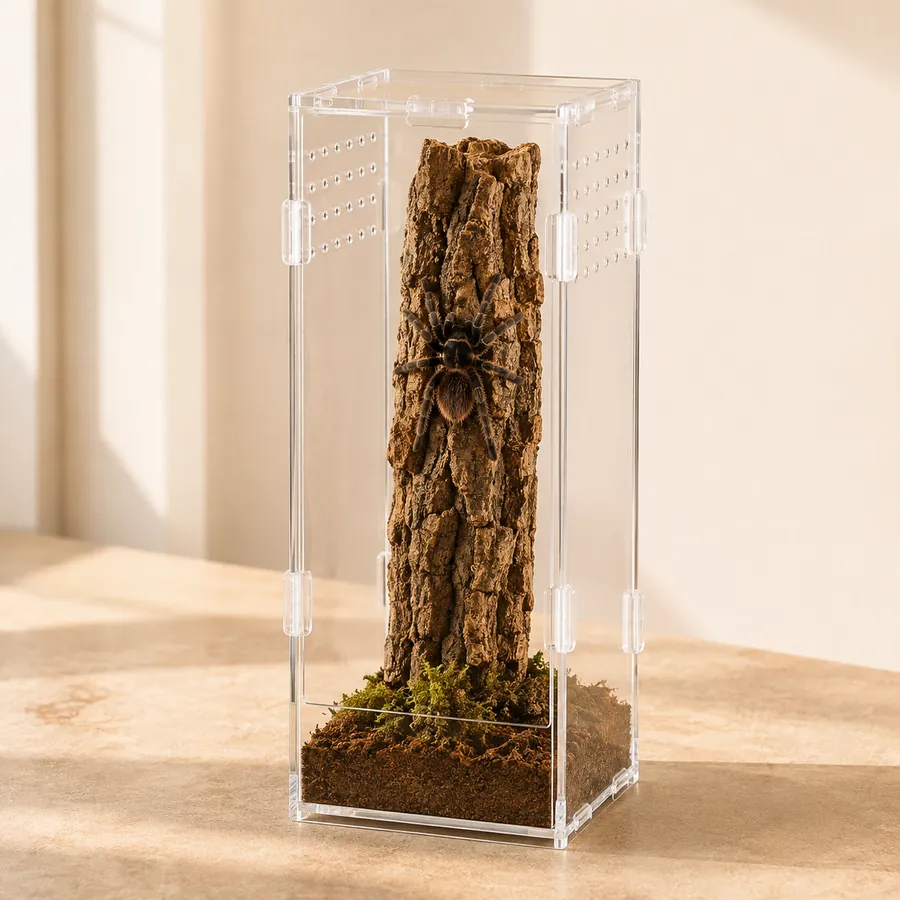
The pink toe (Avicularia avicularia) is the one tree-dweller that regularly makes beginner lists. It is gentle, fluffy and beautiful, with pink-tipped feet on a dark body, and it is more likely to walk calmly than to defend itself. What changes is everything around it: a pink toe is quicker than the terrestrial picks, it can jump, and it lives vertically, so it needs a tall arboreal tarantula enclosure with climbing bark and generous cross-ventilation rather than a wide floor. It is a first tarantula for someone willing to read a little more, and the full housing walkthrough is in the pink toe setup guide.
Species comparison table
Here are the six species side by side. Lifespan figures are the broad ranges keepers commonly report; individual spiders vary with sex, temperature and feeding.
| Species | Temperament | Growth | Lifespan (female / male) | Lifestyle |
|---|---|---|---|---|
| Chilean rose | Calm, occasionally quirky | Slow | ~15–20+ yrs / ~2–5 yrs | Terrestrial |
| Mexican red knee | Docile, showy | Slow | ~20–25+ yrs / ~5–10 yrs | Terrestrial |
| Brazilian black | Exceptionally calm | Slow | ~20+ yrs / ~5–8 yrs | Terrestrial |
| Arizona blonde | Placid, reclusive | Very slow | ~20+ yrs / ~5–10 yrs | Terrestrial |
| Curly hair | Docile, bold feeder | Medium | ~8–10+ yrs / ~3–4 yrs | Terrestrial |
| Pink toe | Gentle but quick | Medium | ~10 yrs / ~2–3 yrs | Arboreal |
Terrestrial species pair with a wide, low enclosure; the pink toe needs a tall one. Slings of every species start small — sizing from sling to adult is covered in the enclosure size by stage guide.
What “friendliest” really means
People searching for the friendliest pet spider usually mean one they can hold, and it helps to reset that picture from day one. A tarantula does not bond with a keeper the way a dog does, and even the calmest species gains nothing from handling: every trip onto a hand is a fall risk for the spider. When keepers call the Brazilian black or the red knee “friendly,” they mean calm, predictable and unbothered by your presence, and by that definition these species absolutely deliver.
Here is the reframe that makes tarantulas such satisfying pets: the interaction is watching, and a good enclosure is the whole interface. Through a clear acrylic wall you see behaviors a hand never shows you — burrowing, web-laying, the slow ambush at feeding time, a molt if your timing is lucky. A tarantula in a scratched, cloudy or oversized box is a pet you lose track of; the same animal in a clear, well-scaled enclosure is a living display piece you check every time you walk past. That is why the enclosure decision matters more for a tarantula than for almost any other pet.
From my own shelves
Visitors always gravitate to the same two enclosures in my room: the Brazilian black sitting in the open like a statue, and the pink toe in its web tunnel up against the acrylic. Neither spider has ever been on my hand. Nobody who watches them for five minutes feels short-changed by that.
Are tarantulas hard to keep alive?
No — the beginner species above are among the lowest-maintenance animals in the pet trade. They need feeding roughly once a week, a topped-up water dish, room temperature and no lighting, heating or filtration. An adult can be left alone for a vacation in a way no dog, cat or fish tank allows. Skipped meals that would alarm a new keeper are normal behavior, especially for the Chilean rose and Arizona blonde.
The risks that do exist are nearly all housing risks. A fall from too much height can rupture a heavy terrestrial’s abdomen; stagnant, damp air invites mold and mites; a loose lid ends with a spider behind the bookshelf. Notice that none of these is about the animal being fragile — each one is an enclosure problem with an enclosure solution: low height and deep substrate for ground-dwellers, real cross-ventilation, and a lid that locks. Those criteria, plus access and transparency, are exactly what the choosing guide walks through. Get the housing right on day one and a beginner tarantula is genuinely difficult to fail with.
One behavior every new keeper should know in advance: a tarantula that flips onto its back is not dying, it is molting. Leave it undisturbed, skip the next feeding, and it will right itself with a fresh exoskeleton in due course. Knowing that single fact ahead of time prevents the most common beginner panic there is.
How long do tarantulas live?
Tarantula lifespan runs on two clocks. Females of the slow-growing terrestrial species are famously long-lived: the red knee, Brazilian black and Arizona blonde females in the table above are animals a keeper can measure in decades, not years. Males everywhere live far shorter lives — once a male matures, his remaining time is typically counted in months to a couple of years, whatever the species. That is why keepers who want a long companion ask for confirmed females.
documented lifespan of females in some tarantula species — a first tarantula can be a decades-long companion
— Encyclopaedia Britannica, 2024
For your planning, the practical consequence is simple: the spider may be small today, but the keeping arrangement is long-term. Slow growth also means each enclosure stage lasts years, so a spider bought as a sling will move through its housing sizes at a very relaxed pace.
Quick answers
What is the friendliest spider to have as a pet? Among tarantulas, the Brazilian black and Mexican red knee are the species keepers most often call the calmest. “Friendly” means placid and predictable rather than cuddly: tarantulas are display pets you watch through the enclosure, not animals that seek handling.
Are tarantulas hard to keep alive? No. Beginner species need weekly feeding, a water dish and room temperature. The main real risks — falls, stagnant air and escapes — are housing problems, solved by an enclosure with low height for terrestrials, cross-ventilation and a secure lid.
What is the lifespan of a tarantula? It depends heavily on sex and species. Females of long-lived species such as the Mexican red knee or Arizona blonde are commonly reported past 20 years, while mature males of any species typically live only a few months to a couple of years more.

Adrian Costa · Tarantula keeper, 10+ yrs
Adrian has kept tarantulas for over a decade and has raised dozens of slings to adults, both terrestrial and arboreal. He builds and tests every enclosure on his own shelves before writing about it.
Free shipping · 30-day money-back guarantee · Ships in 8–10 business days