
· Adrian Costa
Cork bark, hides and fake plants: furnishing a tarantula enclosure
Substrate is the floor. Decor is everything on top of it, and it is where a setup quietly goes wrong. Too little and the spider has nowhere to retreat. Too much of the wrong kind and you have built a climbing frame for an animal that should not climb.
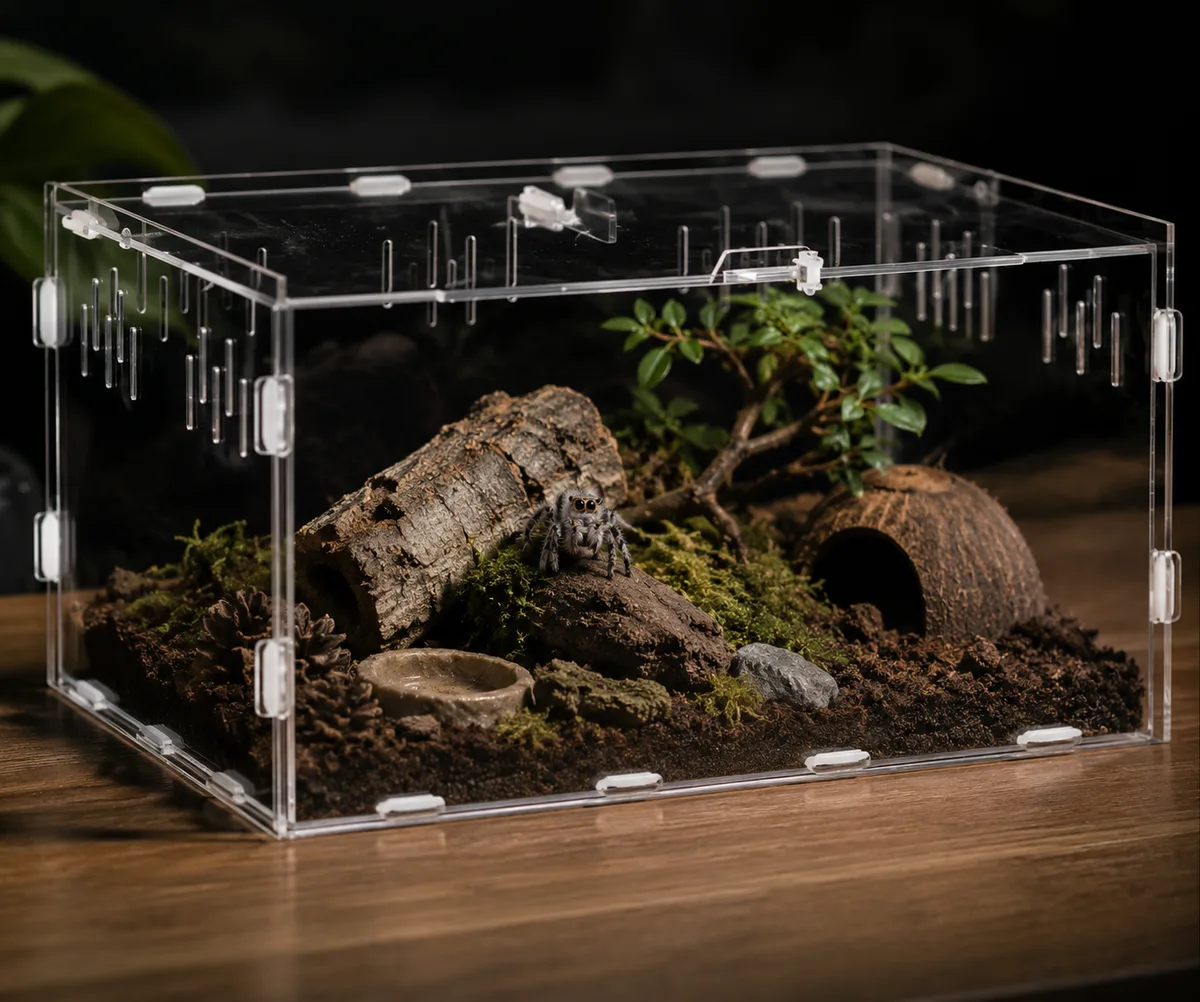
What a tarantula needs above the substrate
Strip the hobby photos back and the list is short: a hide the spider fits fully inside, a piece of cork bark, and a shallow water dish. The plants and the resin ornament are for you rather than the animal, which is fine as long as they are safe and do not eat the floor space.
Worth separating what is settled from what is keeper practice, because the hobby mixes the two. Settled: a tarantula uses a retreat, ground-dwellers are heavy and poor climbers, and nothing carrying pesticide or fertilizer belongs in an enclosure. Keeper practice: the hide dimensions people recommend, and how high is too high. I flag which is which as we go.
The dish counts as decor, because where it sits changes how the enclosure works. Shallow and wide beats deep and narrow. Set it near a corner, away from the burrow entrance and from where you drop feeders, and press it in so it cannot tip. Skip the sponge older care sheets recommend, since it turns into a bacteria trap.
Cork bark: flat, tube or vertical slab
Cork bark is the material nearly every keeper ends up with. It is light, it resists rot in a damp enclosure, and it suits both lifestyles. The shape you buy depends on whether your spider lives on the ground or up a tree.
For a ground-dweller, lay it down. A curved piece half buried at one end becomes a starter burrow many terrestrials will excavate under. Press it in level so it cannot roll or slump if the spider digs beneath. For a tree-dweller, stand it up instead: that setup is covered on the arboreal tarantula enclosure page and in the pink toe tarantula guide, and arboreal vs terrestrial tells you which camp your spider is in.
Hides: what makes one work
The hide is the piece of decor with real welfare value. A spider that can get out of sight eats better, settles faster after a rehousing, and paces the walls less. The requirements are unglamorous: an opening it fits through without squeezing, room inside to turn around, a stable base, no sharp edge.
Coconut half shells, cork tubes and curved bark do the job and cost least. A ceramic reptile cave works only if the entrance is genuinely wide, because a hide the spider cannot enter is an ornament. Size it for the spider you will have in a year, not the one in front of you.
legspan of the largest tarantulas, the Goliath birdeater, the scale a hide has to allow for
— Guinness World Records, 2023
Position matters as much as the object. Set the hide into a corner rather than the middle: a retreat with its back covered reads as safer.
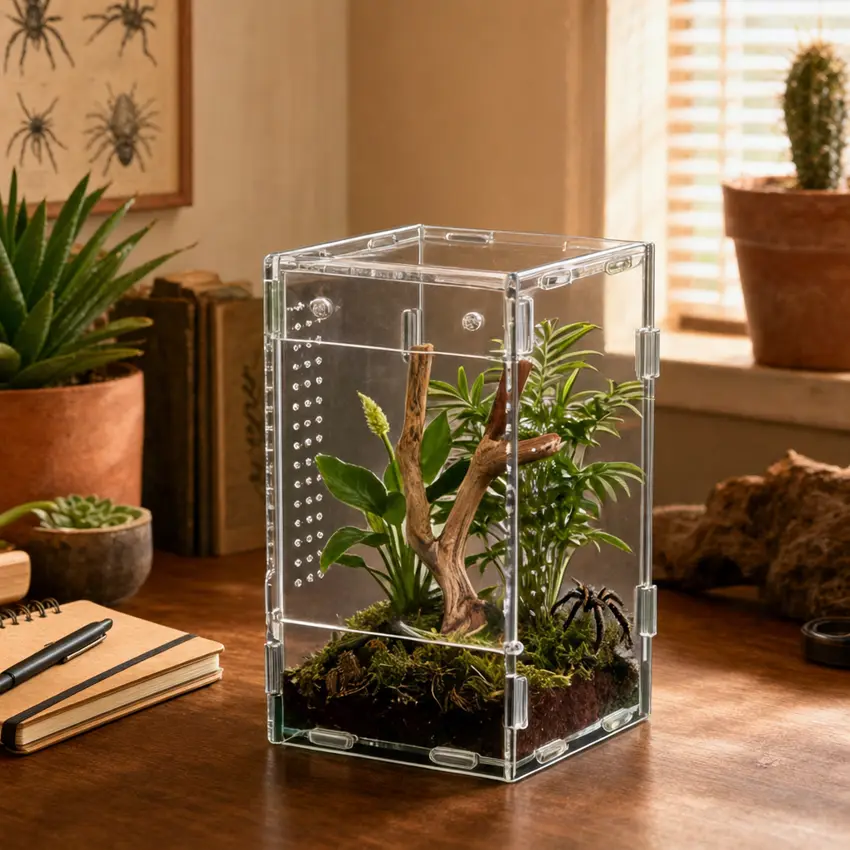
Fake plants, live plants and moss
Fake plants are the low-risk option and there is nothing second-rate about them. They need no light, they do not die when a spider webs over them, and they cannot carry the pesticide or fertilizer residue a garden centre plant might. Rinse them, then wedge the base under the substrate so a heavy spider cannot topple one onto itself.
Silk sprigs do a real job. They break up sight lines so a nervous spider feels covered, and in a tall setup they give an arboreal extra anchor points to web between. Keep the foliage out of the ventilation rows, since decor that blocks airflow undoes what the enclosure is built around, as the ventilation guide explains.
Live plants are a different project. They want light, drainage and a root-friendly substrate, which pulls you toward a full bioactive tarantula enclosure with a cleanup crew, so read that guide before you commit. One verified buyer summed up the display side: "These are great containers to keep some plants or small insects or both in them."
Moss sits between the two. A patch of sphagnum in one corner holds a little humidity without needing light, but keep it a patch rather than a carpet so the substrate underneath can still breathe.
What not to put in the enclosure
This is the part that matters most. The common thread is height and instability.
Be clear about the status of that rule: it is a widely held keeper principle, not a measured injury rate. No trustworthy figure exists, so I will not invent one. The direction of the advice is what counts.
| Keep out | Why | Instead |
|---|---|---|
| Tall or stacked decor for a terrestrial | Something for a heavy spider to climb and fall from | Every piece low, bark flat |
| Heavy rocks and ornaments | Can shift or sink into a burrow dug underneath | Light cork and coconut, pressed level |
| Wild wood used as found | May carry pesticide residue, mold or pests | Reptile-grade cork, or wood heat-treated |
| Sharp or rough resin edges | Abrasion risk against a soft abdomen | Smooth edges only |
| Anything covering the vents | Kills the cross-airflow the enclosure needs | Vent rows clear on every panel |
| Heat rocks and heat mats | Tarantulas do not bask, and a hot floor burns | A warm room at normal temperature |
Two more come up often: painted or varnished ornaments, where you have no idea what the coating is, and decor with a narrow gap a spider can wedge into and not back out of.
Decor that respects the floor plan
In a small enclosure every piece of decor is floor space you no longer have. A hide, a dish and a plant can swallow most of the usable ground, and a burrowing spider is left nowhere to dig. Get the shape right before you shop for accessories.
described tarantula species, from dry-scrub ground-dwellers to rainforest tree-dwellers, so no single decor kit suits them all
— World Spider Catalog, 2024
Here is the layout I use on a wide terrestrial enclosure. Bark hide in one back corner, water dish in the opposite front corner, a plant sprig behind the hide, the whole middle left as open substrate. A ground-dwelling adult belongs in something like our terrestrial tarantula enclosure, where floor area is the point.
From my own shelves
The mistake I made for years was decorating for myself. My best-looking enclosures were the ones my spiders used least: too many pieces, no clear path across the floor, a hide half buried behind a plant. When I stripped one back to bark, dish and open ground, the spider was out and visible more often, not less.
Room to furnish
TaranTerra Acrylic Large Wide (10 x 6 x 6 in / 25 x 15 x 15 cm)
More floor than height, so a hide, a dish and a plant still leave open ground to dig and walk.
$59.99 $79.99 Save $20.00
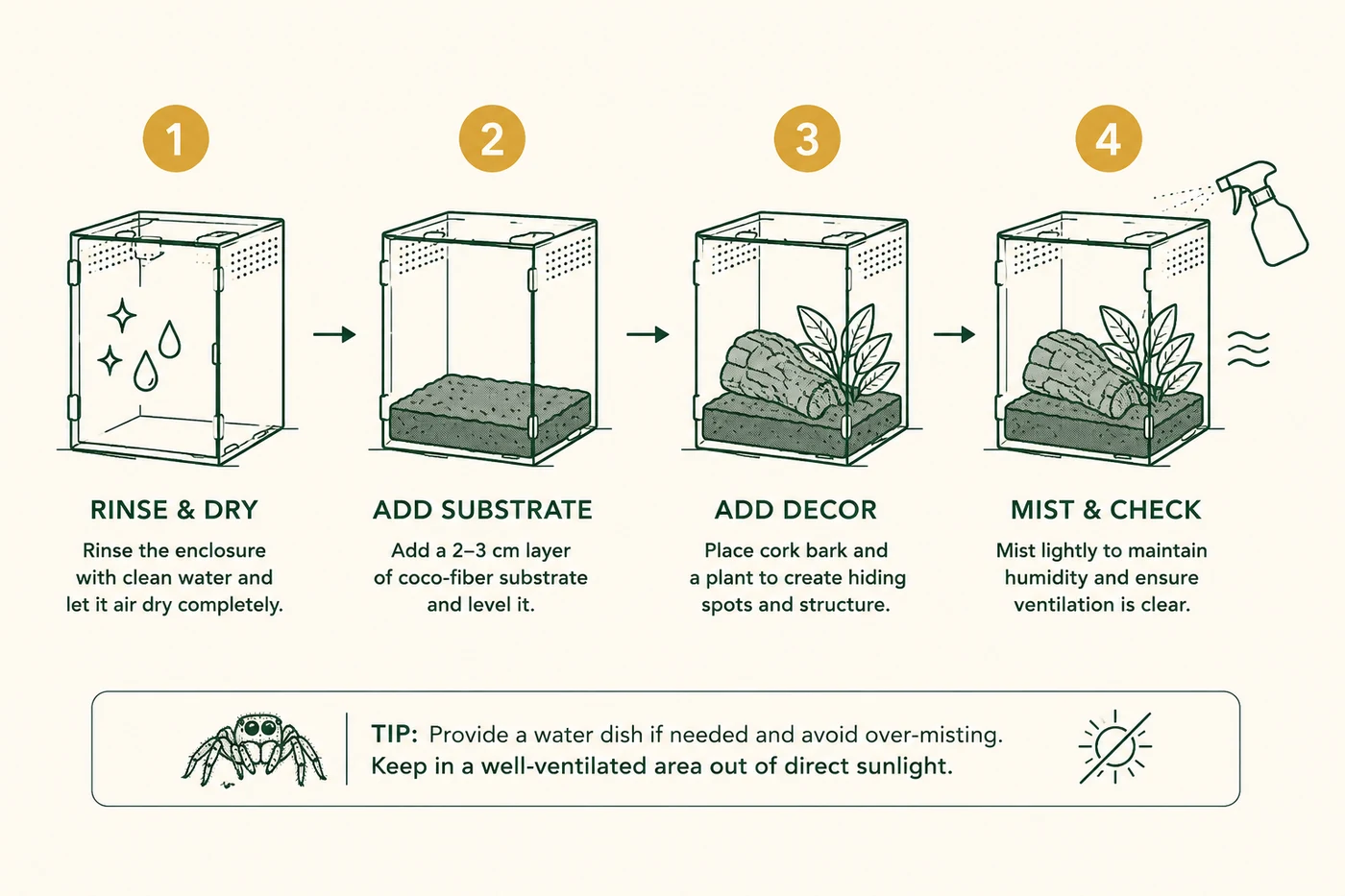
Build it in that order: substrate levelled, hide, dish, then any cover, misting last. Decor you can rinse and reuse beats decor you throw away.
documented lifespan of females in some tarantula species, so reusable furnishings pay off
— Encyclopaedia Britannica, 2024
Still choosing the enclosure itself? The how to choose a tarantula enclosure checklist covers ventilation, access and closures, and the enclosure size by stage guide sizes it. Our method is on the how we test page, buyer feedback on the verified reviews page, the range on the home page. This is a housing guide written by a keeper, not veterinary advice: for a health problem, speak to a qualified exotic-animal professional.
Quick answers
Do tarantulas need decorations? They need a hide and water. Bark, plants and moss are optional cover that helps a spider feel secure.
Are fake plants safe for tarantulas? Yes, when clean and anchored. Rinse them, wedge the base so a heavy spider cannot topple one, and keep the foliage off the vents.
Can I use wood I found outside? Not as found, because it can carry pesticide residue, mold or pests. Reptile-grade cork is the safe default, and collected wood should be heat-treated first.
How much decor is too much for a terrestrial? Too much is when it stops the spider digging, or gives a heavy ground-dweller something tall to climb. Keep the middle of the floor open.

Adrian Costa · Tarantula keeper, 10+ yrs
Adrian has kept tarantulas for over a decade and has raised dozens of slings to adults. He builds and tests every enclosure on his own shelves before writing about it.
Free US shipping · 30-day money-back guarantee · Ships in 8-10 business days