
· Adrian Costa
How to rehouse a tarantula safely, step by step
Rehousing is the moment most new keepers dread: a quick, fragile animal has to move from one box to another without a fall, an escape or a bite. It is also routine: every tarantula raised in captivity is moved several times, and every one of mine has been. Done in the right order, a rehouse takes a few calm minutes. This guide is that order.
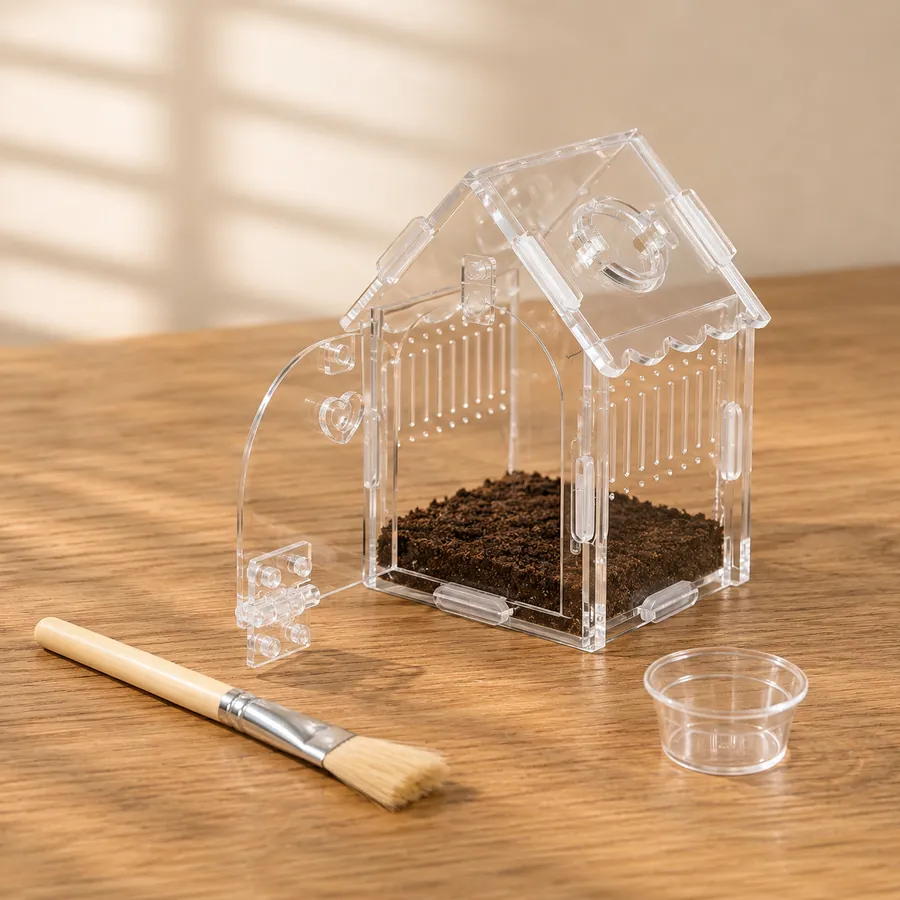
When a tarantula needs a bigger enclosure
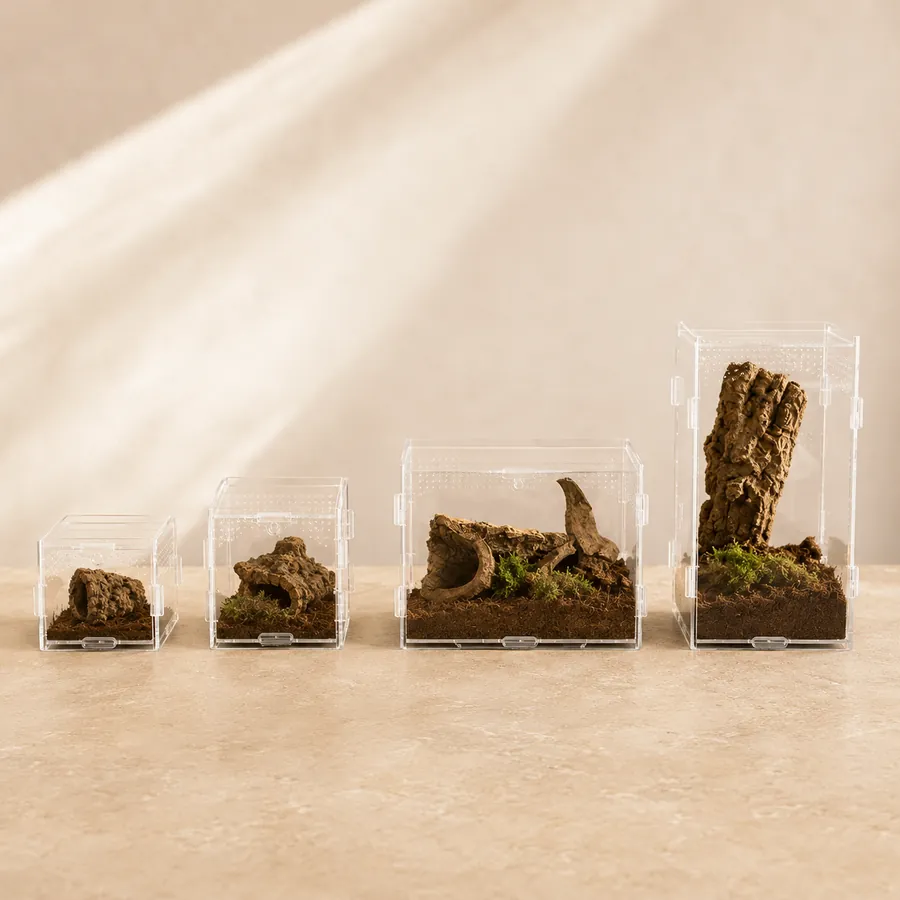
The trigger is the spider, not the calendar: a tarantula only grows at a molt, so the question comes up each time a fresh exoskeleton reveals a bigger animal. This site works from a floor of at least about three times the leg span for a ground-dweller, and the same span in the vertical for a tree-dweller; the sizes by stage are in the tarantula enclosure size guide. From the outside, an outgrown enclosure looks like this.
The spider cannot turn. It touches two walls at once when it pivots, or sits pressed into a corner with its legs bunched rather than spread.
The burrow has hit bottom. A terrestrial that reaches the floor digs sideways along the panels, or gives up and sits on the surface: it needs a wider floor with a deeper layer.
The web is anchored to the lid. An arboreal with no taller point left builds its retreat against the top, so every opening tears it.
One caution: a freshly molted spider looks too big for its home because it is stretched out and pale, and a snug enclosure is not a cramped one. Tarantulas are ambush predators that like a space they control, which is why the size guide warns against generosity, above all for slings. Judge the fit once the spider has hardened and eaten, then move it up one step.
Timing: the molt cycle decides the day
The molt cycle sets the date, not your schedule. A tarantula in premolt has stopped eating, its abdomen has darkened and often looks swollen, the bald patch of a hair-flicking species turns black and shiny, and the spider may seal its burrow or web its retreat shut. Do not rehouse it: a move now can turn a normal molt into a stuck one.
The freshly molted spider is the other no: its exoskeleton is soft, its fangs are pale and it can neither defend itself nor grip. My test is behavioral rather than a count of days: a tarantula is ready once it has taken and finished a meal after the molt, because a spider that hunts has hardened fangs and a body that works. The cleaning guide applies the same rule to a molting spider. Between those two points the window is long, so there is never a reason to rush.
Set up the new enclosure completely first
Finish the new home before the spider leaves the old one, so that nothing needs adjusting while a loose tarantula waits in a cup.
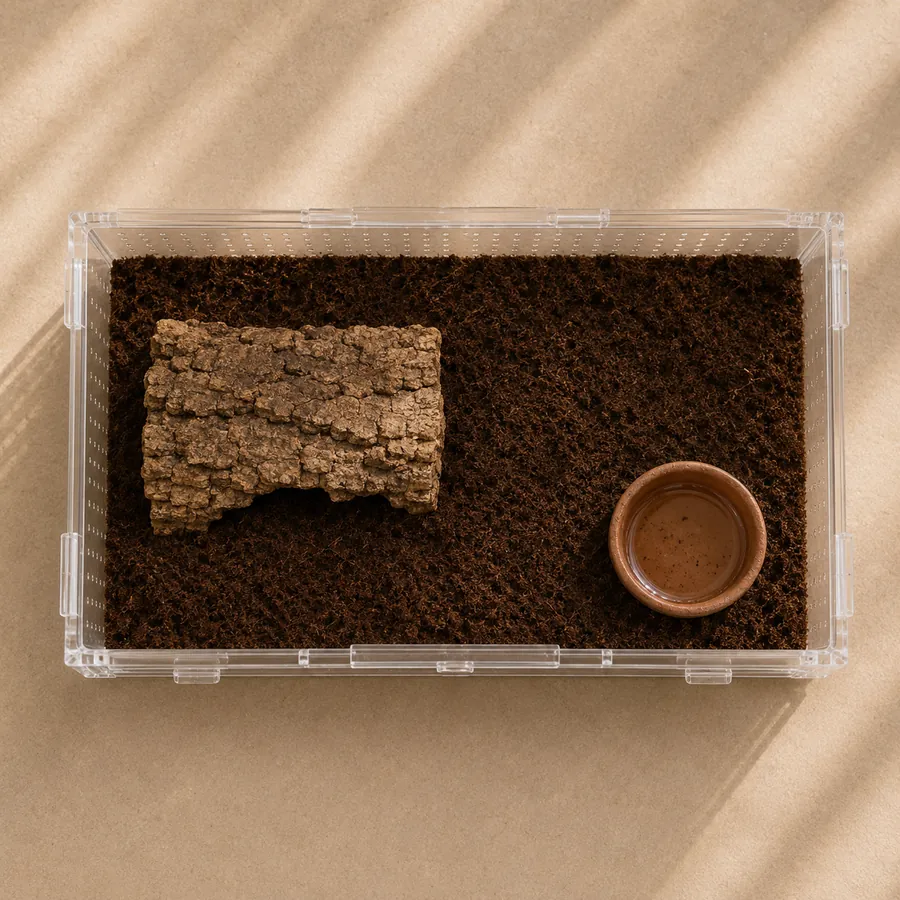
Substrate goes in first and gets pressed down: deep for a ground-dweller, thinner for an arboreal that will live on the bark. The mix and depth by lifestyle are in the substrate guide; what matters here is to dampen it before the move, not after, so you are never misting over a spider that has just arrived. Then the furniture: a hide for a terrestrial, a vertical cork slab for an arboreal, a shallow water dish filled and placed away from the door. The decor guide explains what each piece does. Carry the old hide over if you can: a familiar scent and a ready-made retreat.
Last, test the enclosure empty: close the door, check the magnet holds, run a finger along every seam, and make sure the lid sits flat. Open and close the front door a few times now, while there is nothing inside to escape, so the movement is familiar by the time a spider is on the other side of it.
Prepare the room, the tools and yourself
Rehouse in a closed room, on a low surface, away from any gap the spider could vanish into; an empty bathtub with the plug in works well, because the smooth walls slow a runner. On a desk, clear everything except the two enclosures. Pets and children leave the room first.
The kit is short: a clear plastic cup with a lid, tall enough that the spider cannot reach the rim; a stiff card to slide under it; a long, soft paintbrush; long tweezers for decor. The cup is the tool, the rest is convenience.
Keep your face back and your sleeves down: most New World species, pink toes among them, flick urticating hairs when stressed, and those hairs are miserable in the eyes. Wash your hands and forearms afterwards. And decide now that your hands will not touch the spider: its abdomen is a thin-walled sac, and a fall from hand height onto a hard floor is the injury that actually kills these animals.
On your side of the safety line: the species this site is written around are New World tarantulas whose bites are considered medically minor, but a bite that causes more than local pain and swelling, or any reaction in the eyes from flicked hairs, is a reason to seek medical advice rather than wait it out. For the spider's own health, consult a qualified exotic-animal professional, not a housing guide.
The transfer, step by step
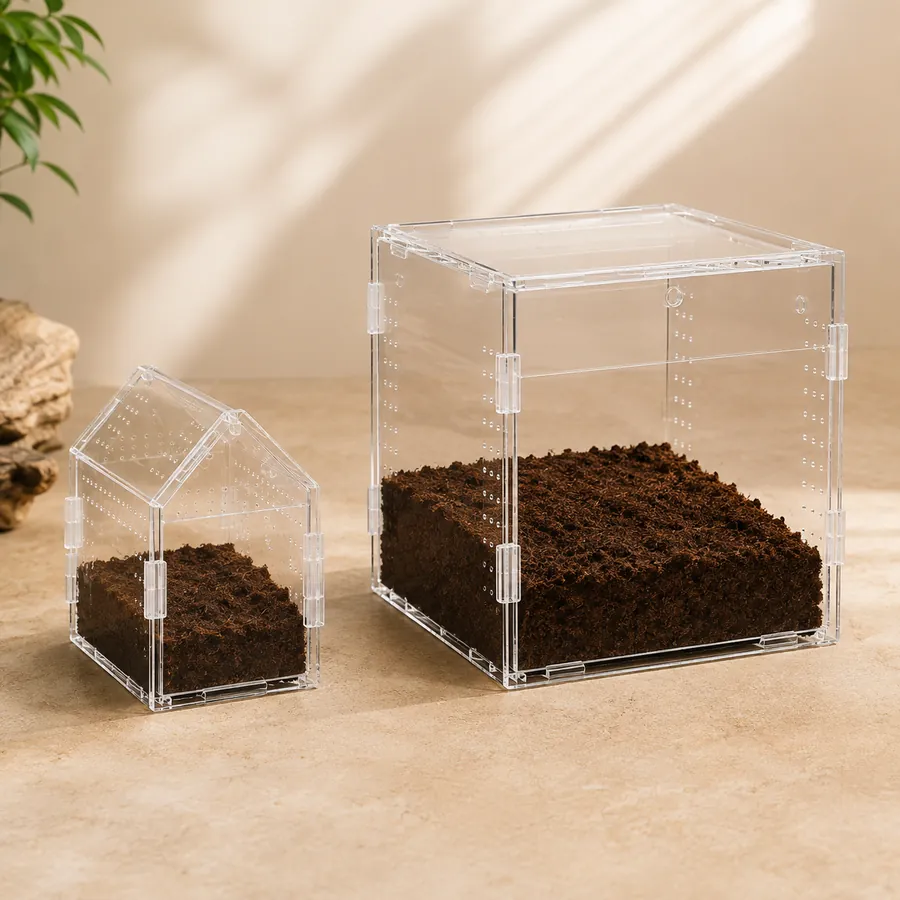
1. Line the enclosures up. Old and new side by side, doors facing you, the new one already open. If the old home fits inside, as a sling vial does, set it in the new enclosure with its opening uncovered and skip to step 6. A House stands taller than the acrylic Small it steps up into, so it goes beside the new enclosure instead, flip door open and facing the open magnetic door.
2. Coax, do not chase. Open the old door and touch the spider gently on a rear leg with the brush. Most tarantulas walk forward, away from a touch. Steer it toward the open front and straight across into the new home. If it walks in, close the door: a good share of my rehouses end here.
3. Cup it if it stalls. If the spider stops, parks on the door or heads the wrong way, lower the cup over it from the front, slowly, and slide the card under the rim. Lift the assembly level: the spider is now in a sealed, transparent box and cannot fall.
4. Set the cup on the new floor. Lower it to substrate level, slide the card out and tilt the cup toward the hide. Let the spider walk out in its own time. Never shake it out: a tarantula tipped upside down lands on its abdomen.
5. Close and check. Withdraw the cup, close the door, confirm the magnet has caught, check the lid, and step back.
6. If it will not leave, wait. A spider deep in a burrow or webbed into a cork tube is never dug out. Leave the old enclosure open inside or against the new one, let the spider move on its own timetable, usually after dark, and remove the empty box once it has.
If it bolts. A running tarantula moves in short bursts and then freezes. Do not grab, do not slap a hand down, do not chase. Stay still until it stops, then cup it where it stands. A terrestrial runs along the floor; an arboreal runs upward, onto your arm if that is the nearest tall thing, so hold the cup above a climber rather than beside it.
Slings and arboreals: the two special cases
A spiderling is too small to steer with a brush and too quick to follow, so do not try to cup it. Set the old container inside the new enclosure if it fits, as a vial does, or stand it against the new door with both openings facing each other, which is how a House hands over to the acrylic Small, and let the sling walk out over the following hours. Keep that new home small: a sling in a large adult box loses track of its prey and its sense of security, which is why the House and the Small exist as steps rather than one leap. The sling enclosure page shows the progression up to the Small and the Medium.
Arboreals add speed and direction. A pink toe rehouses upward, so the cup comes from above, the new enclosure is a tall one with the cork slab already standing, and the cup is emptied against the bark, not on the floor. That tall shape, with the cross-ventilation a climber needs afterwards, is what our arboreal tarantula enclosure is built around. Terrestrials go the other way, onto the floor beside the hide with everything kept low, one more reason a wide, low terrestrial tarantula enclosure is the calmer shape for a ground-dweller to arrive in. Not sure which camp your species is in? The arboreal vs terrestrial guide sorts the common ones.
After the move: let it settle
The rehouse ends when the door closes. A tarantula that has just arrived will pace the walls, sit in a corner or hang from the ventilation panel, and all of that is normal: it is mapping the space. A ground-dweller has settled once it digs or moves into the hide; an arboreal once it lays web on the bark. Do not rearrange anything.
Hold the first meal until the spider has a retreat and sits calmly rather than roaming; a cricket loose beside an unsettled spider is stress on both sides. Remove anything uneaten the next day, as the cleaning routine says.
Two signs mean the setup is off. A terrestrial that sits on the surface instead of digging usually has substrate too dry, too shallow or too loose to hold a burrow. An arboreal that stays on the floor of a tall enclosure is often telling you the air is stagnant, and the ventilation guide is the place to start. Both are enclosure fixes, not reasons to move the spider again.
documented lifespan of females in some tarantula species, so a keeper rehouses the same animal many times over its life
— Encyclopaedia Britannica, 2024
The usual next home
TaranTerra Acrylic Large Wide (10 x 6 x 6 in / 25 x 15 x 15 cm)
Wide floor, room for a deep substrate layer, and a magnetic front door at the spider's level, so the cup goes in and the spider walks out at floor height.
$59.95 $79.95 Save $20.00
From my own shelves
My worst rehouse was my first: a juvenile terrestrial into an enclosure that was not ready, water dish still on the desk, and the spider out of the cup and up the wall before I had turned round. Nothing was hurt, but I spent an evening looking under a bookshelf. Every rehouse since has followed the order above, and the last one, a Brazilian black into a Large Wide, took less time than filling the water dish.
Still deciding which size or shape the spider is moving into? The enclosure size by stage guide sets it out, the how to choose a tarantula enclosure checklist covers door, lid and airflow, our verified reviews show how buyers use the range, and the how we test page sets out our method.
Quick answers
How often does a tarantula need rehousing? Each time it outgrows its floor, which only happens at a molt. Slings step up often, juveniles a few times, and a slow-growing adult can stay in one enclosure for years. Move up one size at a time.
Can I rehouse a tarantula by hand? No. Guide it with a soft brush and a clear catch cup. Hands add a fall risk for the spider and a bite or hair risk for you.
What if my tarantula will not come out of its old enclosure? Do not dig it out. Leave the open old enclosure inside or against the new one and let the spider move on its own.
Should I feed before or after a rehouse? Rehouse a spider that has eaten since its last molt, then hold the next meal until it has settled into a retreat.

Adrian Costa · Tarantula keeper, 10+ yrs
Adrian has kept tarantulas for over a decade and has raised dozens of slings to adults, both terrestrial and arboreal. He builds and tests every enclosure on his own shelves before writing about it.
Free shipping · 30-day money-back guarantee · Ships in 8–10 business days